Global fabrication is becoming more demanding, mobile, and cost-sensitive. Fortune Business Insights’ Welding Equipment Market report valued the global market at approximately USD 15.4 billion in 2023. It projects continued growth through 2032. This expansion reflects rising construction, energy, shipbuilding, and infrastructure activity. It also increases pressure on welding teams to move equipment safely and efficiently.
A Track Welding Dolly can support this need by carrying welding machines, gas cylinders, cables, and tools along prepared rails or uneven work areas. On a busy fabrication floor, that may mean fewer trips between a power source and a joint. It may also reduce cable drag around steel sections, platforms, and temporary work zones. The International Federation of Robotics reported more than 500,000 industrial robots installed globally in 2023. That figure signals a broader shift toward organized, productivity-focused production environments. However, welding work remains partly manual, especially during maintenance, field installation, and customized fabrication.
The choice is practical. It is not universal.
A reliable model should match load capacity, wheel or rail design, braking control, corrosion resistance, and regional safety expectations. ISO 11228-1 provides useful guidance for manual handling assessment, although it does not replace a site-specific risk review. Buyers should inspect frame weld quality, cylinder restraint, spare-part access, and operating instructions before ordering. Some suppliers emphasize maximum capacity too heavily. That can mislead buyers when floor conditions, gradients, or operator habits differ. A Track Welding Dolly is valuable when its design fits the actual workflow, not merely when its specification sheet looks impressive.
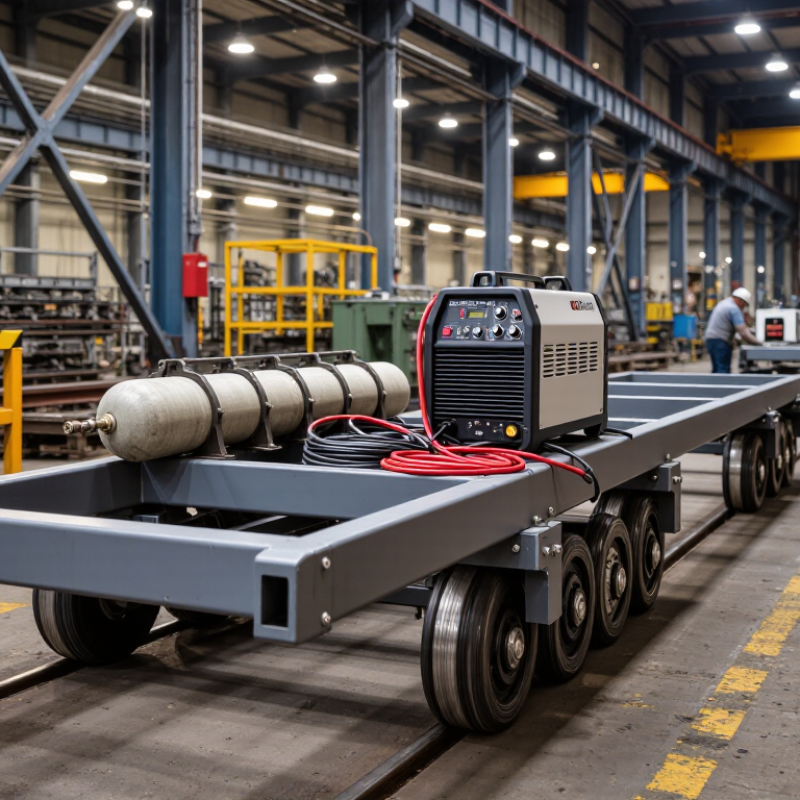
A track welding dolly is a powered carriage that moves a welding torch along a fixed rail or guide track. It helps maintain a steady travel path and reduces hand movement during long seams. For global buyers, the stated 100–1,500 mm/min travel-speed range is an important specification. Lower speeds support deeper heat input on thicker joints. Higher speeds can suit longer seams and thinner materials.
However, speed alone does not guarantee a sound weld. Motor torque, rail alignment, carriage load, torch angle, wire-feed rate, and shielding gas all affect results. In practical workshop use, a speed near 100 mm/min may create excessive heat if the current is too high. At 1,500 mm/min, incomplete fusion may occur if settings are not adjusted. The advertised maximum might also apply only to an unloaded carriage. That detail deserves verification.
Tips: Ask for a speed calibration record and a practical test video. Check whether the dolly keeps a stable pace over rail joints. Confirm power requirements, control response, and emergency stopping performance. Run a sample bead before production. It is a small step. Yet operators sometimes skip it, and that can make an expensive machine look unreliable. A supplier with clear technical data, test procedures, and service documentation is easier to evaluate across different working environments.
For global buyers, a track welding dolly is more than a transport aid. It creates a controlled path for torch travel, helping operators maintain steadier speed, angle, and overlap. ISO 3834-2:2021 does not mandate a dolly. It requires controlled welding processes, qualified personnel, suitable equipment, inspection, and traceable records. Track guidance supports these controls by reducing avoidable movement during long seams.
This matters when production teams face skills pressure. The American Welding Society’s 2023 workforce report projected a U.S. shortage of about 330,000 welding professionals by 2028. The U.S. Bureau of Labor Statistics projects about 42,600 annual openings for welders, cutters, solderers, and brazers through 2033.
Guided travel cannot replace a qualified welder, but it can make repeatable work easier to teach and verify. A rail, magnetic base, or fixed guide can hold the torch near the planned joint line. A calibrated speed setting can also support consistent heat input.
Small details matter.
A buyer should request WPS and WPQR compatibility, travel-speed limits, calibration methods, emergency-stop performance, and maintenance records. ISO 3834 quality depends on the complete system, not one accessory.
In practice, a dolly may reduce weave variation, yet poor fit-up, dirty steel, or incorrect shielding gas can defeat its benefit.
Guidance is not magic. Field trials on representative plate thicknesses remain wise, because published specifications rarely reveal every floor-level limitation.
Why Choose a Track Welding Dolly for Global Buyers?
Which Load, Duty-Cycle, and Positioning Data Matter for Global Buyers?
A track welding dolly should match real workshop conditions, not only a headline capacity. Check the rated load, including the torch, cable bundle, fixtures, and any temporary attachments. A 100-kilogram rating may become unsuitable when cables drag behind the carriage. Measure the complete working setup.
Duty cycle deserves equal attention. A machine rated for continuous movement may still require pauses during welding, cooling, or alignment. Ask whether the duty-cycle figure applies to travel, welding, or both. These details are often unclear. That uncertainty deserves a written answer from the supplier.
Positioning data should describe repeatability, travel speed, control response, and stopping tolerance. For long seams, even a small positioning error can affect bead consistency. Review speed ranges at low movement settings, not only maximum speed. Test the dolly on the actual rail profile, if possible. A smooth floor test can mislead.
Global buyers should also compare power input, control voltage, wheel compatibility, and operating-temperature limits. Local electrical conditions may differ from the test environment. Keep records of measured speed, load, stopping distance, and cable behavior. The data may expose weaknesses early. It may also challenge your original choice. That is useful. A reliable purchasing decision leaves room for inconvenient findings.
| Dolly Class | Rated Load (kg) |
Typical Duty Cycle (at 40°C) |
Travel Speed (mm/min) |
Track Gauge (mm) |
Positioning Repeatability (mm) |
Recommended Workpiece Diameter (mm) |
Typical Application |
|---|---|---|---|---|---|---|---|
| Compact | 1,000 | 20% ED | 80–1,200 | 500–1,000 | ±1.0 | 300–1,200 | Light-duty circumferential welding and small fabrication work |
| Standard | 2,000 | 35% ED | 60–1,000 | 600–1,200 | ±0.5 | 600–2,000 | General tank, pipe, vessel, and structural fabrication |
| Heavy-Duty | 3,000 | 50% ED | 40–800 | 800–1,500 | ±0.3 | 1,000–3,000 | High-volume welding of large-diameter vessels and heavy sections |
Why Choose a Track Welding Dolly for Global Buyers?
IP54–IP65 protection makes a welding dolly more dependable in demanding workshops. Under IEC 60529, IP54 resists limited dust ingress and water splashes. IP65 provides dust-tight protection and resistance to low-pressure water jets. This difference matters near grinding stations, washdown areas, and open workshop doors.
In daily use, wheels cross metal dust, damp floors, and scattered welding debris. A protected motor housing can reduce contamination-related failures. However, IP ratings do not confirm impact resistance, chemical resistance, or fire safety. That limitation deserves attention. The International Labour Organization estimated 2.93 million work-related deaths and 395 million non-fatal injuries annually. Safer material movement can support better workshop control, but it cannot replace inspections or operator training.
Tips: Match the rating to the real environment, not the brochure image. Choose IP54 for sheltered, relatively dry areas. Consider IP65 where dust clouds and water jets are common. Check seals, cable glands, connectors, and drainage points every month. Keep the dolly away from direct sparks and hot slag. Also review local electrical requirements before import and installation. A higher IP number is useful, but not automatically better for every site.
Why Choose a Track Welding Dolly for Global Buyers?
A track welding dolly can improve travel consistency on long welds. In field use, stable wheels reduce sudden starts, uneven bead spacing, and operator fatigue. However, AWS D1.1 does not certify the dolly itself. It governs structural steel welding practices, including procedures, qualifications, workmanship, and inspection. Buyers should confirm that the machine supports the approved welding process and maintains the required travel speed.
CE marking addresses another responsibility. For European markets, suppliers must identify applicable safety requirements, complete conformity assessment, prepare technical documentation, and provide a declaration of conformity. Look for guarded drives, emergency stopping, clear controls, and electrical protection. A neat label is not enough.
Safety starts earlier.
ISO 12100 provides a framework for identifying hazards and reducing risks through design. During evaluation, inspect pinch points near the rail, cable movement, hot surfaces, tipping risks, and access around the workpiece. Ask for risk assessment records, operating limits, maintenance instructions, and evidence from comparable applications. These details reveal more than polished product photographs.
A practical trial is valuable. Place the dolly on the actual track, attach the intended torch, and observe its movement beside a heated joint. Small issues appear quickly. Cable drag may disturb alignment. A narrow wheel may collect spatter. One assumption can fail. Global buyers should also verify voltage compatibility, language requirements, spare-part access, and local service capability before purchase.
How AWS D1.1, CE, and ISO 12100 Shape International Equipment Selection
A track welding dolly should be selected by checking structural welding quality, machinery risk controls, guarding, emergency stopping, technical documentation, and market-specific conformity requirements. The timeline highlights the reference years of key international frameworks that influence this evaluation.